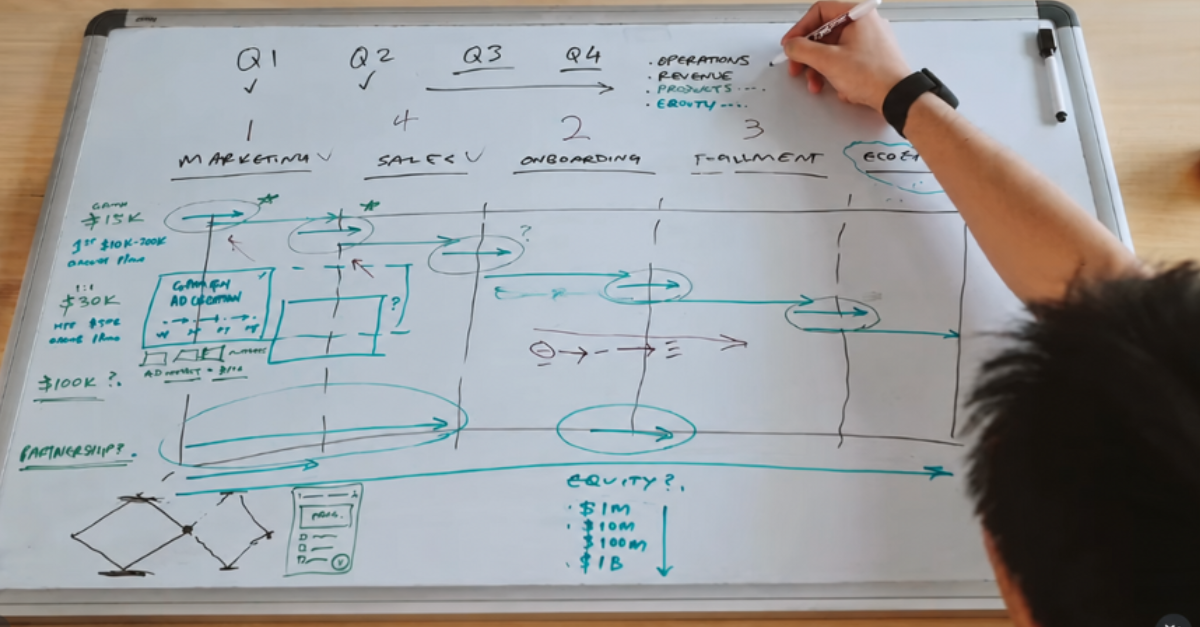
Your Business Runs on Invisible Systems
Chent Thambiah · 1 November 2026 · 6 min read

Who decides what happens next in your business, and where is that written down?
In a recent mentorship call, I explained to a founder why we weren't going to test his platform together. When two people check things side by side, the time disappears, and somewhere in the middle nobody can say whose list the problems end up on, mine or his. It gets messy fast. So we agreed a rhythm instead. We meet and go through the updates, we make the executive decisions, then we split up: I build, he tests, and each of us keeps our own record. We come back with findings, decide the next round and go again.
The problem was never effort. Nobody had decided where the record lived, so each of us assumed, and the assumption cost us time. Every business has versions of this: rules about who decides, where things get recorded and how work passes from one person to the next, none of them written down. They run the place whether you designed them or not.
If your business feels harder to run than it should and you can't point at the cause, this is how I'd go looking for it.
What an invisible system is
A system is any repeatable way of getting work done. An invisible one has never been designed or documented. It's habit, assumption and whoever happens to be in the room. "Ask Sam, she knows" is a system. So is the rule that nothing goes out until you've seen it, and so is the chat thread where decisions get made and then lost.
None of these is a failure. Most started as a sensible shortcut. The trouble is that you can't improve something you can't see, and you can't hand it to someone else.
Why you don't notice them
Invisible systems work well enough, right up until the business changes. In a small team, everyone remembers how things go. Add people, clients and volume and the same unspoken rules meet far more decisions, with far more people guessing. What used to run on memory starts running on luck.
That's why the symptoms are so hard to trace. Things get done twice, or not at all. The same question gets asked three times. Nothing is obviously broken, and everything takes longer than it did.
Where they hide
In my experience they gather in four places.
Where things get recorded. In the testing example, the work wasn't the problem. The question of whose list it went on was. When nobody has decided where the record lives, information scatters and people spend their time reconciling it.
Who decides, and what they decide. In one product I was involved in, support issues came in as a stream. The answer was a simple triage: minor, moderate and major, with only the major ones going to the lead. Before that rule existed, every issue was a fresh decision and every decision needed the same person.
How work passes between people. Handovers fail quietly. The person handing over knows the standard so well they never say it, and the person receiving it guesses.
What rhythm things run on. Most teams have a cadence, such as when updates happen, when decisions get made and when everyone goes away and works, and it's rarely stated. Once we named ours (touchpoint, decisions, build and test separately, reconvene), it stopped depending on anyone remembering it.
How to make one visible
You don't need a systems overhaul. You need one honest look at something that keeps costing you time.
- Pick one thing that keeps going wrong or taking longer than it should. Late deliveries, repeated questions, a task that always lands on the same person.
- Trace what actually happens. Not what should happen. Who does what, where it's recorded, who decides, and what happens when the usual person is away.
- Decide what to do with it. Some invisible systems are fine and just need naming. Some need fixing. A few need replacing.
- Write it down while you do the work. With the support triage, the plan was to build the process as the team went, not to design it in advance. That's the cheapest time to document anything, because you're doing it anyway.
- Review it after a few rounds. The first version will be wrong in places, which is how it gets better.
When the idea left her head
Nadine is the founder of Louder People, which she launched through grounded execution and a strategic repositioning of what she was building. When we started working together she was stuck in a familiar place: overthinking, perfectionism and ideas that stayed ideas. She's since begun developing Digital Rooms for creators, artists and brands.
Looking back, I'd say the invisible system governing her business was the rule that nothing leaves your head until it's right. Nobody writes that rule down, and it governs everything, because right never arrives. What moved things wasn't more thinking. It was putting a visible process in place: deciding what to launch, repositioning it, and executing step by step. The vision launched, and the systems that now carry it exist because she created them on purpose, instead of letting them form by default.
Signs your business runs on invisible systems
- Answers live in one person's head. "Ask her" is the documentation.
- The same question keeps coming back. Nobody can point to where the answer is.
- Work stalls when one person is away.
- Two people each assume the other has it.
- You can't say where something gets recorded.
- New people learn by watching and guessing.
What I'd take from this
You already have systems, so the question is whether you can see them. The ones you can see are the ones you can improve, delegate or leave alone on purpose. The rest decide quietly how your business behaves, and they get more expensive as it grows.
Start small, with one thing that keeps costing you time, and write down what really happens before you try to fix it. A few questions help:
- What does my business do every week that I never decided?
- Where does the record of a decision actually live?
- What would stop if one particular person were away for two weeks?
- Which handover relies on someone guessing the standard?
- What am I making a fresh decision about that could be a simple rule?
If you suspect your business is running on rules nobody has written down, let's have a chat. We'll walk through how it actually runs, what's holding together by habit, and what's worth making visible first. That's the work I do through OnePercent Consulting.